BYD Surpasses 1.02 Million Employees, Exceeding Toyota, Tesla, Ford and General Motors Combined
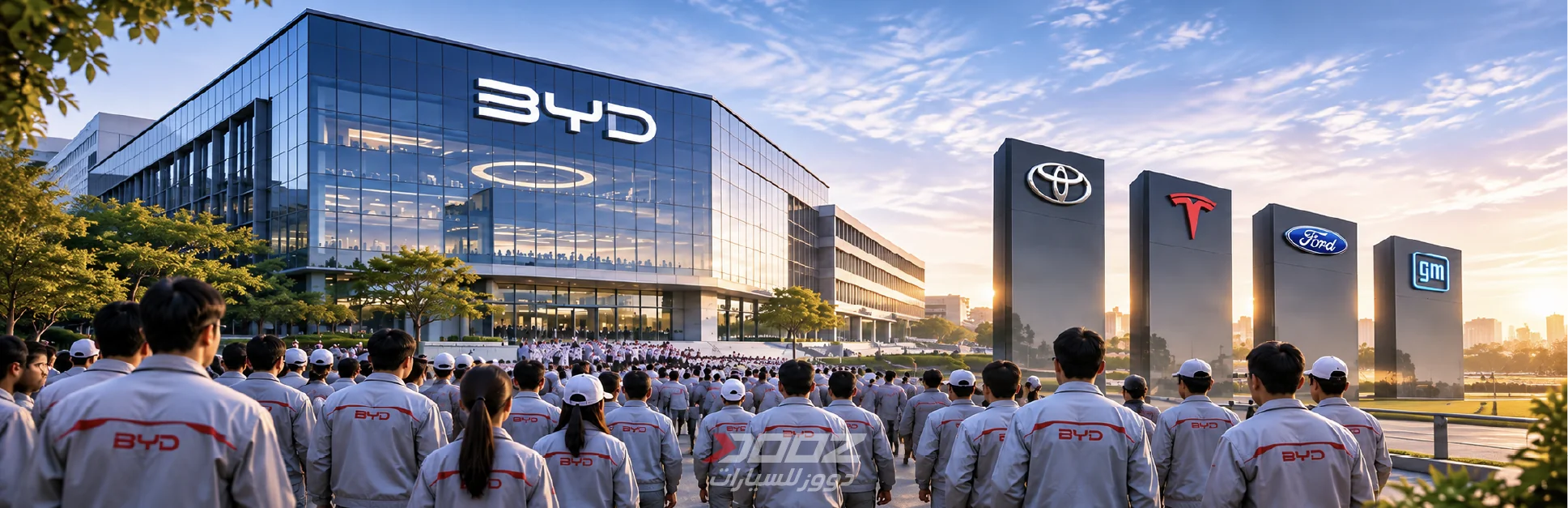
Chinese automaker BYD has reached a remarkable milestone in its workforce, with its total number of employees worldwide exceeding 1.02 million. This makes the company larger in terms of workforce than four major automakers combined: Toyota, General Motors, Ford and Tesla, according to BYD Chairman Wang Chuanfu.
The announcement was made on Wednesday, October 28, 2026, during the 33rd annual conference of the China Society of Automotive Engineers (SAE-China). Wang revealed that BYD's workforce had surpassed 1.02 million people, including approximately 960,000 employees in China and 60,000 overseas.
He also noted that the company employs around 120,000 engineers and researchers in research and development (R&D), working across key technological fields, including battery cells, electric motors, electronic control systems and semiconductors. This highlights the scale of BYD's investment in developing its own technologies and components.
BYD Adds Approximately 150,000 Employees in Ten Months
The latest figures reveal significant workforce expansion at the Chinese company. BYD had approximately 869,600 employees at the end of 2025, before its workforce increased to more than 1.02 million in October 2026.
This means the company added approximately 150,000 employees in around ten months, representing workforce growth of nearly 17% compared with the end of last year.
This expansion follows a period of significant workforce fluctuations. BYD had approximately 570,100 employees at the end of 2022, increasing to 703,500 by the end of 2023, before reaching approximately 968,900 employees at the end of 2024.
However, 2025 marked a shift in this trend, as BYD reduced its workforce by approximately 99,000 employees, bringing the total down to around 869,600 by year-end. The reductions were mainly concentrated in direct production and manufacturing-line positions.
The company subsequently resumed workforce expansion in 2026. Data compiled by S&P Global Market Intelligence showed that BYD had approximately 911,900 employees at the end of June, before Wang Chuanfu announced that the figure had exceeded 1.02 million in October.
BYD has not yet provided a detailed breakdown of the sectors that absorbed all the new employees. However, reports have pointed to expanded recruitment at some of its manufacturing facilities, including its production base in Xi'an, which announced more than 8,000 job openings in September 2026.
More Employees Than Toyota, Ford, General Motors and Tesla Combined
BYD's workforce is not only remarkably large within the automotive industry but also exceeds the combined employee count of several of the world's leading automakers.
According to figures cited in Electrek's report, the workforce of these competing companies stood at:
- Toyota: 390,927 employees as of March 31, 2026.
- Ford: Approximately 169,000 employees at the end of 2025.
- General Motors: Approximately 156,000 employees at the end of 2025.
- Tesla: 134,785 employees as of December 31, 2025.
Combined, these four companies employ approximately 851,000 people. This means BYD has around 170,000 more employees than all four companies combined, based on the reported figures.
For further comparison, Volkswagen Group employed approximately 662,942 people at the end of 2025, including its joint ventures in China, while Stellantis reported approximately 258,668 employees at the end of the same year.
These figures highlight the scale of BYD's operational structure. However, the comparison concerns total workforce numbers rather than employees directly involved in vehicle manufacturing, given the differences in business activities and subsidiaries included in each company's figures.
Why Does BYD Need More Than One Million Employees?
BYD's large workforce is closely linked to its vertically integrated business model, which involves developing and manufacturing many of its own components and technologies rather than relying entirely on external suppliers.
The company's operations extend beyond electric and plug-in hybrid vehicle production to include batteries, electric motors, semiconductor chips and electronic control systems, as well as consumer electronics, energy storage and rail transportation.
One of the major contributors to its workforce is BYD Electronic, a subsidiary specializing in manufacturing and assembling electronic devices for other brands. The company employed approximately 165,000 people at the end of 2025.
BYD also operates extensive battery manufacturing businesses. Its batteries are not exclusively used in its own vehicles but are also supplied to other automakers. Its operations further include semiconductors, motors, energy storage systems and other industrial activities.
This means BYD's total employee count reflects the scale of a diversified industrial and technology group, rather than a company focused solely on vehicle assembly.
120,000 Engineers and Researchers: R&D at the Heart of BYD's Strategy
The presence of approximately 120,000 engineers and researchers is one of the most notable figures revealed by Wang Chuanfu during the conference, particularly because these specialists work in fields directly related to the future of electric mobility.
Their areas of expertise include battery cell development, electric motors, electronic control systems and semiconductors, all of which are essential technologies for improving the efficiency and performance of electric and plug-in hybrid vehicles.
BYD's roots date back to 1994, when it was established as a battery manufacturer. The company entered the automotive industry in 2003, building on its expertise in battery technology and manufacturing.
Over the years, BYD expanded its in-house technological capabilities and component development, eventually becoming one of the world's leading companies in the new energy vehicle sector.
During his speech, Wang Chuanfu described BYD's journey as a reflection of the transformation of China's automotive industry, from catching up with global automakers to competing for leadership in the sector.
Wang also received the 2026 Rao Bin Award during the conference, an award recognizing contributions to China's automotive industry.
Workforce Growth Despite BYD's Sales Challenges in 2026
One of the most notable aspects of these figures is that BYD's workforce expansion comes at a time when the company is facing sales challenges, particularly in China, where competition and price wars among electric and hybrid vehicle manufacturers remain intense.
According to official production and sales figures published by BYD in October 2026, the company sold approximately 3,131,576 new energy vehicles during the first nine months of the year, compared with approximately 3,260,146 vehicles during the same period in 2025, representing a decline of 3.94%.
However, September sales showed a clear improvement, with BYD selling 463,561 vehicles, up 16.98% compared with the same month a year earlier. This marked the company's strongest monthly performance of 2026 up to that point.
Meanwhile, international markets have become a major source of growth. BYD's overseas sales reached approximately 1,342,960 vehicles during the first nine months of 2026, an increase of 92.7% year over year, accounting for nearly 43% of its total sales during the period.
These results indicate that BYD continues to expand its global presence despite domestic market pressures, with exports and international markets playing an increasingly important role in its growth strategy.
Does a Larger Workforce Mean Higher Productivity?
Despite BYD's significant lead in total employee numbers, this does not necessarily mean the company is more productive than its competitors in vehicle manufacturing.
According to Electrek's comparison, BYD sold approximately 4.6 million new energy vehicles in 2025, with around 869,600 employees at year-end. This translates to approximately 5.3 vehicles per employee.
By comparison, Tesla delivered 1,636,129 vehicles during the same year with 134,785 employees, equivalent to approximately 12 vehicles per employee. Volkswagen Group recorded around 13.5 vehicles per employee, based on the calculations cited in the report.
Toyota, meanwhile, recorded global sales of approximately 11.3 million vehicles in 2025, including its Daihatsu and Hino subsidiaries. This translates to approximately 29 vehicles per employee using the workforce figure included in the comparison.
However, these calculations do not provide a precise or directly comparable measure of productivity, because BYD's employee count includes business segments that are not directly involved in vehicle manufacturing, such as electronics, batteries, semiconductors, energy storage and rail transportation.
The companies also differ in their operational structures, subsidiary coverage and reporting dates.
BYD Continues Its Transformation from a Battery Manufacturer into a Global Industrial Group
BYD's workforce surpassing 1.02 million employees reflects the company's transformation since its establishment in 1994, evolving from a specialized battery manufacturer into a diversified industrial group operating across multiple sectors, led by electric vehicles and new energy vehicles.
This expansion highlights BYD's strategy of developing and controlling key technologies and components in-house, alongside its substantial investments in research and development and manufacturing operations.
Nevertheless, BYD's real challenge is not simply increasing its workforce or manufacturing capacity, but turning its operational scale into sustainable growth in sales and profits while strengthening its competitiveness in global markets, particularly as competition in the electric vehicle industry continues to intensify.
To stay updated with the latest car news and information, download the Dooz Cars app.

Global Partnership Between BYD and Paris Saint-Germain Until 2029
3 months ago

Nissan Tekton 2026 Officially Debuts: Full Specifications and Prices of the Mini Patrol
3 months ago

How BYD Transformed from a Modest Startup into a Global Electric Vehicle Giant
3 months ago


BYD Recruits James Bond to Launch the Luxury Z9 GT with 5-Minute Charging Technology
7 months ago
