Honda announces its first annual loss, hit by $15.7 billion in EV-related charges.
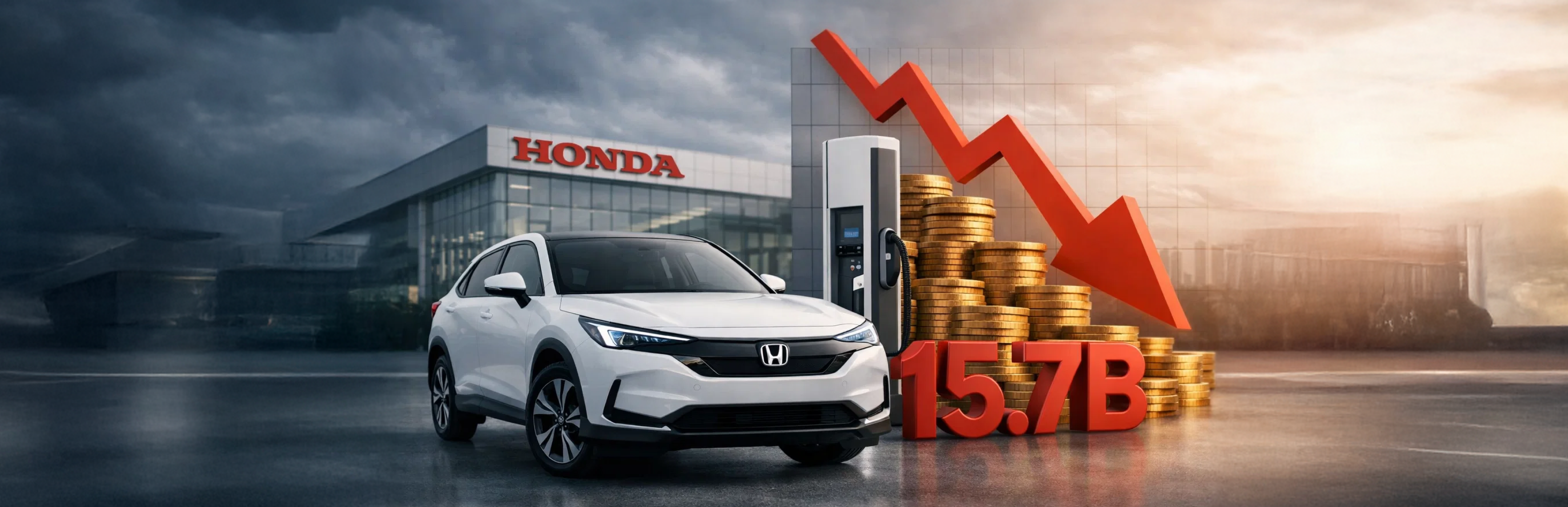
In a surprising development that puts the traditional automotive sector to a difficult test, Honda Motor Co. has forecasted its first annual loss since its stock market listing in 1957. This significant loss—which could reach 2.5 trillion yen (approximately $15.7 billion)—is the result of a bold strategic decision to cancel the launch of three electric vehicle models previously planned for the U.S. market. This move aims to reassess investment viability amid rapidly accelerating changes in the global business environment.
Why did Honda's strategy stumble?
The problem is not just about "building a car," but about the "timing of expenditure":
- The Expectation Gap: Honda invested heavily in an EV market expected to grow rapidly in the U.S.; however, the "cooling" of global demand for these vehicles turned those investments into a heavy financial burden.
- Chinese Technological Superiority: In China—the world's largest automotive market—competition is no longer based on mechanical engine quality, but on "intelligent software systems." Chinese companies have bridged the gap with remarkable speed, leaving traditional manufacturers (including Japanese and European firms) in a technological race where they are losing market share to vehicles offering more advanced and integrated digital user experiences.
- Forced Restructuring: Writing down the company’s investments in China is more than a financial measure; it is an acknowledgement of the urgent need for new strategies. This may include focusing on hybrid engines as a more realistic alternative for consumers, and prioritizing emerging growth markets such as India.
Asset Protection and Rule Changes
In another aspect of this crisis, the company has adjusted its strategy for dealing with "impounded vehicles," shortening the legal timeframe for putting them up for sale from two years to just one if their status is not rectified. This measure aims to protect the company's asset value and avoid losses caused by the sharp depreciation of vehicles stored for long periods.
In the ever-changing world of automotive, survival belongs to the smartest and those most adaptable to evolution. With Dooz, you aren't just buying a car—you are investing intelligently. Stay tuned with us to remain at the heart of the action, and rely on Dooz to simplify every step of your journey.
For more details and original sources of the news.
