100,000 Cars Stranded in Hormuz.. Global Shipping Crisis Hits Middle East Imports and Land Routes Emerge as Alternatives
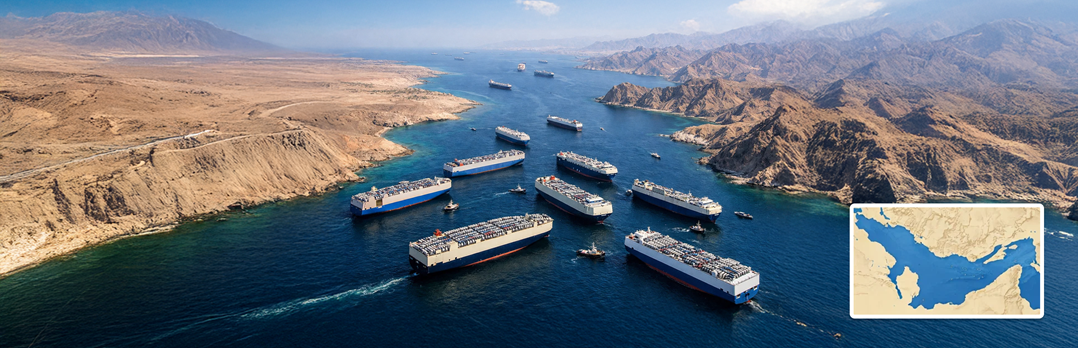
The crisis of detaining car carriers in the Strait of Hormuz has disrupted the flow of Chinese imports to Middle Eastern markets, forcing ship operators to discharge vehicle shipments at nearby alternative ports. Simultaneously, consecutive rises in oil prices have begun affecting automotive supply chains in Asia by increasing logistics costs, accelerating demand for electric vehicles, and disrupting the supply of petrochemical materials.
According to Robert Willmington, markets editor at Lloyd’s List Intelligence, a total of 15 car carriers have been detained as a result of the ongoing conflict, representing about 3 percent of the total global shipping fleet. These vessels typically carry between 6,000 to 8,000 cars each, with most originating from the Far East.
Willmington stated that most of these ships originate from the Far East, with only one from Europe, and this is significantly impacting car imports into the Middle East, especially since China, Japan, and South Korea have become the primary export markets for the region. Data indicates that the volume of Asian car imports to the Middle East exceeds one million units annually.
New Developments.. Analysis of Key Points
1. Strategic Diversion via Jeddah Gateway and Hybrid Shipping
To counter the risk of detention in the Arabian Gulf, major Chinese shipping companies such as COSCO and Japanese firms have begun implementing an emergency plan based on discharging their cargoes at Jeddah Islamic Port on the Red Sea. From there, cars are loaded onto massive transport trucks to cross Saudi territory reaching Jordan and the rest of the region by land. This route, while safer, adds new operational costs related to land transport and road insurance, which may reflect on the final price for the consumer.
2. Surge in Aluminum Prices and Impact on Manufacturing Costs The London Metal Exchange recorded a sharp rise in aluminum prices by 8 percent, bringing the price per ton to 3,370 dollars. Since modern cars for the year 2026 rely heavily on aluminum to reduce weight and increase battery efficiency, this rise pressures the profit margins of manufacturers, pushing them to raise factory delivery prices for upcoming 2027 models.
3. S&P Global Warnings of Regional Sales Contraction Experts at S&P Global Mobility issued a report warning that the regional market could lose about 200,000 units of its expected sales for 2026. This contraction is not due to a lack of demand, but rather a supply gap resulting from ship delays and route diversions, which could create long waiting lists for certain high demand models, especially Japanese and Chinese SUVs.
4. Brent Crude Hits One Hundred Dollars and the Final Blow to Gasoline Engines With Brent crude prices fluctuating between 92 and 100 dollars per barrel, operating traditional gasoline cars has become a significant economic burden. This reality has prompted Asian manufacturers, particularly in China, to fully direct their investments toward accelerating electric vehicle production lines. Expectations indicate that 2026 will be the year of the great shift in the Middle East, where consumers will find that electric vehicles are the only alternative to escape fuel price fluctuations and high logistics costs.
Locally.. Temporary Stability in Jordan
The Jordan Automobile Dealers Association JADA confirmed that car prices in the Kingdom are currently stable thanks to the presence of sufficient strategic inventory covering demand until the end of the second quarter of 2026. The association explained that any rise in shipping or insurance costs will only apply to new shipments that have not yet reached the Kingdom.
Dooz Guidance
Global fluctuations are rapid and accurate information is your weapon for a smart buying decision. Download the Dooz app now to know the updated car prices in Jordan moment by moment, and compare specifications and inventory availability at dealers and showrooms with ease. Our app gives you the clear picture of the local market status and the impact of global shipping costs on prices, ensuring you get the best value for your investment.
Sources
- Automotive Logistics.. Report on detained ships and shipping routes via Jeddah.
- S&P Global Mobility.. Analysis of the impact of the Iran conflict on global and regional car sales.
- Jordan Pulse.. Statements from the Jordan Automobile Dealers Association regarding price stability.
- IEA.. Oil market report and the impact of high prices on supply chains.
