A Parent’s Safety Checklist: How to Choose a Safe and Fuel-Efficient Car for Your College Student
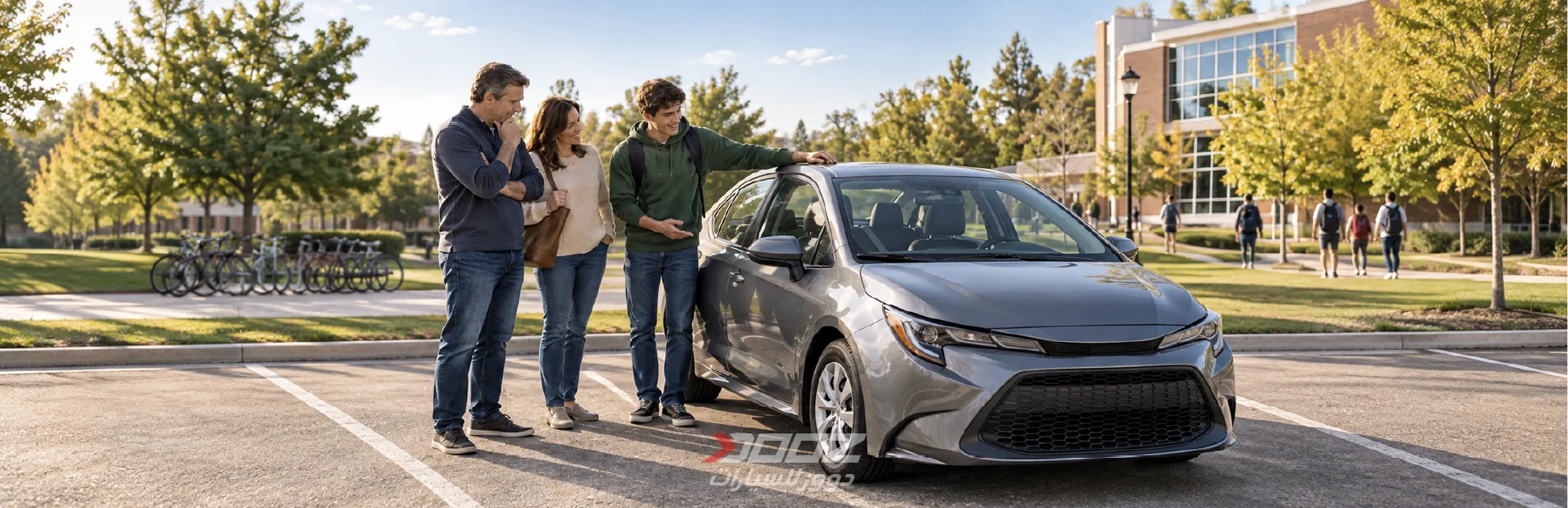
Choosing a car for your college-age son or daughter should not begin with price or appearance alone. A more important question is: Is the vehicle safe enough, and are its running costs suitable for the family budget?
As college students gain greater independence behind the wheel, factors such as safety technology, vehicle size, fuel economy, ease of maintenance, insurance costs, and the condition of a used vehicle become far more important than horsepower or cosmetic features.
According to the Insurance Institute for Highway Safety (IIHS), teen drivers are about three times as likely to die in a crash as drivers aged 20 and older, largely because immaturity and inexperience create a high-risk combination. Choosing the right vehicle is therefore an important part of reducing risk.
For families in Jordan, fuel efficiency is also an important consideration. The Ministry of Energy and Mineral Resources fixed the September 2026 price of 90-octane gasoline at 1.000 Jordanian dinars per liter, while 95-octane gasoline was set at 1.310 dinars per liter.
The ideal college car is therefore not necessarily the smallest or cheapest one. Instead, it should provide a balanced combination of safety, reliability, fuel efficiency, ownership costs, and ease of driving.
What Should Parents Look for in a College Student’s Car?
Before getting into the details, the decision can be simplified into six questions:
Is the vehicle safe in a crash?
Can it help prevent some crashes?
Is its size appropriate for a new driver?
Is its fuel consumption reasonable?
Are maintenance and spare parts readily available?
Is the vehicle in good condition, especially if it is used?
If a vehicle fails on one of these key areas, price alone should not determine the purchase decision.
1. Don’t Choose the Smallest Car Simply Because It Is Economical
One common misconception is that the smallest car is automatically the safest and most economical choice for a student.
However, IIHS advises against choosing vehicles that are too small or too light for young drivers. Its guidance recommends a curb weight of at least 2,750 pounds, approximately 1,247 kilograms, because heavier vehicles generally provide greater protection for their occupants in crashes with other vehicles.
That does not mean parents need to buy a huge SUV. Very large vehicles can be more difficult for inexperienced drivers to handle and may create greater risks for other road users. A moderately sized vehicle can therefore offer a better balance.
What Size Works Best?
Parents can consider:
- A well-built compact or small-to-midsize sedan.
- A compact hatchback with adequate weight and crash protection.
- A compact SUV, provided it is not excessively large or high-performance.
The key is to find a vehicle that provides strong protection while remaining easy to control and maneuver.
2. Safety Systems Matter More Than the Number of Features
A vehicle may have a huge infotainment screen, ambient lighting, power seats, and a premium sound system while lacking important safety technology.
For a college student, priority should be given to systems designed to help prevent crashes or reduce their severity.
Automatic Emergency Braking — AEB
AEB monitors the road ahead and can automatically apply the brakes when an imminent collision is detected.
NHTSA identifies automatic emergency braking as an important driver-assistance technology and explains that it can help prevent some forward collisions or reduce their severity.
Forward Collision Warning
This system alerts the driver when the vehicle is approaching another vehicle too quickly and a collision may be imminent.
Blind Spot Warning
This can be particularly useful for new drivers because it alerts them to vehicles traveling in areas that may be difficult to see through the mirrors.
Lane Departure Warning and Lane Keeping Assistance
These systems can warn the driver when the vehicle unintentionally leaves its lane, while some systems can provide steering assistance to help keep the vehicle within the lane.
Rear Cross-Traffic Warning
This technology can be useful when reversing out of parking spaces or areas with limited visibility.
Rear-View Camera
A rear-view camera should not replace direct observation, but it provides an additional layer of visibility when reversing.
3. Don’t Buy a Very Powerful Car Just Because It Looks Like a Better Deal
Another common mistake is buying a high-performance vehicle because it appears to offer more power for the money.
IIHS advises young drivers to stay away from sports cars and high-horsepower models, as high power can encourage speeding and make the vehicle more demanding for an inexperienced driver.
That does not mean the vehicle has to be underpowered. The priorities should instead be:
Control + Stability + Safety + Efficiency
rather than:
Power + Acceleration + Sporty Performance
Electric vehicles also deserve special consideration because their electric motors provide immediate torque and can deliver rapid acceleration.
4. Crash-Test Ratings Matter More Than Personal Impressions
It is not enough to say that a vehicle "looks strong" or "feels solid."
Before buying, parents should check independent crash-test results from organizations such as IIHS, NHTSA, and Euro NCAP.
IIHS explains that its ratings assess both crashworthiness — how well a vehicle protects occupants in a crash — and crash avoidance and mitigation, including technologies that can prevent crashes or reduce their severity.
Euro NCAP's current rating system evaluates vehicle safety across areas including safe driving, crash avoidance, crash protection, and post-crash safety.
When comparing vehicles, parents should also remember that safety specifications can vary according to model year, trim level, and market.
5. Never Buy a Used Car Without Checking Its History and Condition
For families on a tighter budget, a used car can be a sensible option. But a safe used car is not simply a cheap car.
Parents should check:
Accident History
Has the car been involved in a serious crash? Has the chassis or airbag system been repaired?
Structural Condition
The pillars, frame areas, floor, and key structural components should be inspected carefully.
Airbags
Make sure all airbags are present, functional, and have not been replaced with unsuitable components.
Safety Systems
Check that systems such as ABS and ESC are functioning properly.
Tires
Old or worn tires can create a significant safety risk even when the vehicle itself has strong safety credentials.
Brakes
The brake discs, pads, and overall braking system should be professionally inspected.
Maintenance
Ask for service records whenever possible and review oil, filter, fluid, and other maintenance intervals.
Recalls
IIHS recommends checking for open recalls before purchasing a used vehicle, using the VIN or license plate where supported, and continuing to monitor recalls over time.
6. "Economical" Means More Than Fuel Consumption
When parents say they want an economical car for their child, they should consider the total cost of ownership, not fuel consumption alone.
A useful calculation is:
Vehicle price + fuel + maintenance + tires + insurance + registration fees + potential repairs
A vehicle may be cheaper to purchase but more expensive to own if it requires frequent repairs or costly parts.
Conversely, a slightly more expensive vehicle may deliver better fuel efficiency and lower maintenance costs over time.
7. Is a Hybrid Car a Good Choice for a College Student?
In many cases, a hybrid vehicle can be an attractive option for reducing fuel consumption, particularly in urban traffic and stop-and-go driving.
However, the decision should not be based on the word "Hybrid" alone.
Parents should compare:
Purchase price + fuel economy + warranty + maintenance costs + parts availability + resale value
For a used hybrid, the hybrid battery and electrical system should be inspected by a qualified specialist before purchase.
Fully electric vehicles introduce a different set of considerations, including charging availability, daily driving distance, warranty coverage, and battery condition when buying used.
Dooz Advisor: One More Step Before Making the Decision
If you are choosing between several vehicles or are unsure which option best fits your child’s needs and your family’s budget, Dooz Advisor can provide an additional layer of guidance before you make a purchase.
The idea is simple: instead of choosing a vehicle based only on price or appearance, consider practical factors such as daily usage, budget, fuel consumption, safety level, and maintenance costs to narrow the options to vehicles that better match the driver’s needs.
This can be especially useful when comparing a new vehicle with a used one, or when choosing between different models and trim levels.
8. Don’t Ignore Headlights and Tires
These details may seem less important than airbags and driver-assistance systems, but they are an essential part of everyday safety.
IIHS reports that nighttime crash rates are substantially lower for vehicles with good or acceptable headlight performance than for vehicles with poor headlights.
Parents should also check:
Tread depth, tire age, tire pressure, and the condition of the spare tire.
A safe vehicle needs good contact with the road just as much as it needs effective airbags and crash-avoidance technology.
9. An Easy-to-Drive Car Is Better Than an Impressive One
For a new driver, being able to judge the vehicle's dimensions and maneuver it confidently can be more important than having luxury equipment.
Look for:
- Good visibility from the driver's seat.
- A rear-view camera.
- Parking sensors.
- Appropriate vehicle dimensions.
- A reasonable turning radius.
- Predictable throttle response.
- Effective brakes.
- A comfortable driving position.
Do not let your child choose based on design alone.
The most important step is to sit behind the wheel and evaluate:
Visibility, braking, steering, acceleration, parking, and reversing.
10. Safety Does Not End When You Buy the Car
Even the safest vehicle cannot compensate for dangerous driving.
NHTSA stresses that driver behavior and human error remain central to road safety, while IIHS highlights speeding, passengers, distractions, and nighttime driving as important areas for parents to address with young drivers.
Parents should establish clear rules concerning:
Seat belts, mobile-phone use, speed, passengers, and nighttime driving.
According to the CDC, seat belts reduce serious crash-related injuries and deaths by about half.
Parents’ Checklist Before Buying a Car for a College Student
Safety
- Does the vehicle have strong crash-test ratings?
- Does it have ESC?
- Does it have sufficient airbags?
- Does it have AEB?
- Does it offer blind-spot monitoring?
- Does it have a rear-view camera?
Vehicle Condition
- Is the vehicle free from serious structural damage?
- Has it been independently inspected?
- Are the airbags original and functional?
- Are the tires and brakes in good condition?
- Is there a clear service history?
- Are there any open recalls?
Costs
- How much fuel does it use?
- How much will insurance cost?
- What are the regular maintenance costs?
- Are spare parts readily available?
- What is the expected resale value?
Usage
- Will it mainly be used in the city or for longer trips?
- Does the driver actually need a large vehicle?
- How many kilometers will it travel each year?
- Is charging available if it is an EV?
- Can the new driver comfortably control its size and dimensions?
Dooz Summary: What Is the Ideal College Car?
Choosing a vehicle for a college student is about much more than buying a way to get from one place to another. It is a decision involving safety, reliability, budget, and everyday use.
From Dooz's perspective, there is no single vehicle that is perfect for every student. The right choice depends on the driver's needs and circumstances. The process should therefore begin with the budget, expected daily mileage, usage pattern, and safety priorities, followed by a careful comparison of available options.
Ultimately, neither price nor appearance should be the deciding factor. The best car for your child is one that provides a strong level of safety, has operating costs the family can comfortably manage, and is easy for the driver to control with confidence and responsibility.
With Dooz, choosing the right car starts with making the right decision before the journey begins.
