From CarFax to AutoScore: How to Read Car Inspection Reports in Jordan and Detect Fraud
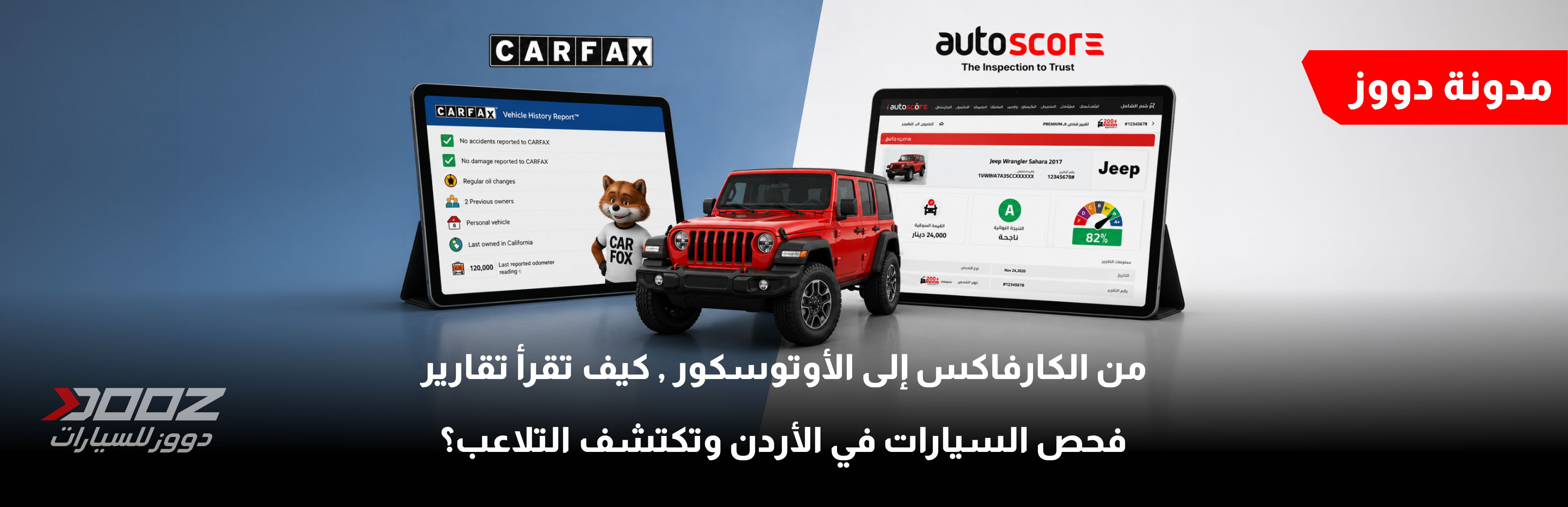
Jordan's automotive market is undergoing a radical shift toward digital technology, driven by the massive surge in electric (EV) and hybrid vehicles. With this evolution, fraud and manipulation tactics have also advanced. Traditional inspection methods relying on "visual experience" or outdated local slang like (minor chassis dent), (light hit), or (curb strike) are no longer enough to protect you.
If you are planning to buy a used or imported car in the Kingdom, your investment decision must be built on two essential reports that dominate today's market: the CarFax report for the vehicle's international history, and the AutoScore system for its current technical and engineering evaluation.
1. CarFax Report: The Secret Ledger for Imported Cars
If the vehicle you want to buy is imported from the US or Canadian markets (which represent the largest share of EVs and hybrids in Jordan, such as Tesla, Toyota, and Ford), the CarFax report serves as its "birth certificate." It uncovers everything that happened to the vehicle overseas, from the moment of manufacture until its export.
What is CarFax and Where Does it Get its Data?
Derived from "Car History Facts," CarFax is the largest digital automotive database in North America. CarFax does not physically inspect the vehicle; instead, it connects a massive information network comprising more than 100,000 official and private sources, including:
- Government DMVs (Departments of Motor Vehicles): To document official ownership changes and mileage readings.
- Major Insurance Companies: To log accidents, damage severity, and payout values.
- Major Salvage Auctions (such as Copart and IAAI): The primary platforms where crashed cars are sold before being exported.
- Authorized Service Centers and Dealerships: To track routine maintenance, oil changes, and manufacturer recalls.
- Police and Civil Defense Reports: To monitor severe collisions, floods, and fire incidents.
A Detailed Breakdown of a CarFax Report
When reading the report, you must focus on 5 core sections:
First: Title Status and Legal Condition ⚠️ (The Most Critical)
This section determines the car's legal status in its country of origin, featuring critical terms:
- Clean Title: The vehicle is legally sound and was never written off by an insurance company (though it might still have undergone cosmetic paint or minor scratch repairs).
- Salvage Title: The car suffered a major accident where repair costs exceeded 70-80% of its actual value, causing the insurance company to declare it a "total loss" or "written off." (The majority of crashed cars imported to Jordan fall under this category before being repaired locally).
- Rebuilt / Reconstructed: A vehicle that was previously branded as "Salvage" but was repaired, re-inspected, and re-registered in the US, making it legally roadworthy there again.
- Flood / Water Damage: A vehicle submerged due to floods or hurricanes. This is the worst-case scenario for modern electric vehicles due to the corrosion of complex electronic wiring harnesses.
- Lemon Title: A car that suffered from a recurring factory defect that the dealership failed to fix, forcing the manufacturer to buy it back under consumer protection laws (The Lemon Law).
Second: Accident and Damage History (Accident / Damage)
Details the exact location of the impact (front, rear, side), its severity (Minor, Moderate, Severe), and whether the Airbags deployed.
Third: Number of Owners and Usage Type (Ownership & Usage)
Shows how many people owned the car and, more importantly, how it was driven:
- Personal: Personal use (The best option).
- Rental / Lease: Used for rental or commercial leasing (highly prone to wear and tear).
- Taxi / Police: Used as a cab or police cruiser (usually comes with extreme mileage and heavy engine stress).
Fourth: Odometer History
Plots a chronological graph of the mileage. If the mileage drops in any given year compared to the previous one, the system flags a glaring red warning indicating blatant mileage tampering.
Fifth: Service Records
Logs dates and details of oil changes, filter replacements, battery servicing, and components replaced across North American workshops.
Limitations of CarFax: CarFax cannot detect accidents repaired with "cash" at small, independent shops that never reported the incident to the police or insurance companies. Therefore, CarFax reveals the past, while a hands-on technical inspection reveals the present.
2. AutoScore System: The Engineering Inspection Revolution in Jordan
The Kingdom has moved past traditional, subjective inspections thanks to the AutoScore system. This is the first comprehensive vehicle inspection system built on strict scientific and engineering principles, utilizing advanced diagnostic hardware from BOSCH Germany. It holds the global TÜV Rheinland certification and is officially approved by the Jordan Standards and Metrology Organization (JSMO) for inspecting used electric vehicles.
How to Read an AutoScore Report?
The system examines over 200 inspection points throughout the vehicle and awards a final percentage score ("The Score"). It is easily read through the following features:
- Smart Three-Color System:
- 🟢 Green: The component is perfectly healthy and free of notes.
- 🟡 Yellow: Indicates a wear-and-tear note or a moderate flaw that requires attention.
- 🔴 Red: A severe fault or critical defect that compromises vehicle safety and demands immediate repair.
- Integration with the Licensing Department: The report cross-references the vehicle's local history with the Jordanian Drivers and Vehicles Licensing Department (DVLD) records to ensure data consistency and track accidents within Jordan.
- Interactive Media: The digital report goes beyond text, embedding live photos and videos documenting the exact location and nature of technical faults.
- X-Ray Structural Body Scanning: AutoScore's latest breakthrough technology; an advanced scanner sweeps the exterior body to generate highly accurate 2D maps. Within just 10 minutes, it reveals exactly where body filler (putty/bondo), extra paint, welding, or chassis cuts exist—leaving zero room for human error.
AutoScore Unveils New Vehicle Inspection Technology in Jordan
3. Common Fraud Tactics in Jordan’s Car Market & How to Spot Them
Unscrupulous sellers use sophisticated digital and mechanical tricks to hide vehicle flaws. Here is how you can expose them:
A. Odometer Tampering
- The Trick: Rolling back the odometer to deceive the buyer into thinking the car has low mileage, thereby artificially inflating its price.
- How to Detect It: Perform a Triple Cross-Match. Compare the car's current odometer reading with the last recorded mileage on the CarFax report (before export) and the mileage documented in the DVLD records via the AutoScore report. Any logical discrepancy confirms tampering.
B. Concealing Chassis Structural Damage with Professional Body Filler
- The Trick: Following a severe crash that results in cut pillars or a bent chassis, workshops meticulously realign and paint the car using high-end body filler (putty/bondo), which easily tricks traditional magnets and the naked eye.
- How to Detect It: Rely on AutoScore's X-Ray scanning technology. The scan penetrates paint layers to highlight structural welding and putty thickness, displaying them vividly in red on the digital screen.
C. Temporary Clearing of Computer Error Codes (Clearing DTCs)
- The Trick: When a costly fault occurs in a hybrid battery or electric motor drivetrain, the "Check Engine" or warning light turns on. Some sellers clear these Diagnostic Trouble Codes (DTCs) using cheap OBD scanners. The warning light stays off for about 30 km—long enough to trick the buyer during a test drive and inspection—only to reappear shortly after purchase.
- How to Detect It: AutoScore’s BOSCH-powered diagnostic tools read the vehicle's deep History Codes and check the actual State of Health (SOH) of the battery. This immediately reveals whether the fault system was recently wiped without an actual repair.
D. The Fake Paper Report Trap
- The Trick: The seller prints out a physical CarFax report but uses Photoshop to erase red-flag words like "Salvage" or "Flood."
- How to Detect It: Never accept printed paper reports provided by the seller. Insist on viewing the live, direct digital link from the official website, or grab the 17-digit Vehicle Identification Number (VIN) from the dashboard and pull the report yourself.
E. The "Crooked Traditional Inspector" Phenomenon
- The Trick: The seller stubbornly insists on taking the car to a specific traditional inspection shop in Amman or Zarqa that relies on subjective human judgment, where vague, flexible phrasing is used to hide major flaws.
- How to Detect It: Exercise your right as a buyer to choose the inspection venue. Head to fully automated, tech-driven centers like AutoScore across their digitized branches (such as Bayader, Tabarbour, and the Free Zone), where results are fed electronically straight from the diagnostic machines without any human bias.
The Golden Checklist for Jordanian Car Buyers
To guarantee a 100% secure purchase, follow these steps in order:
- Independent VIN Verification: Get the 17-digit VIN directly from the vehicle's dashboard or door jamb and purchase the CarFax report yourself or through trusted, direct digital platforms.
- Reject Ready-Made Reports: Do not rely on any inspection paper or history sheet handed to you by the seller.
- Inspect at an Independent, Automated Center: Choose a facility that relies on computerized hardware, AI diagnostics, and X-ray imaging (like AutoScore) to guarantee absolute neutrality.
- Verify Battery State of Health: If the car is an EV, demand a detailed reading of the battery cell health and SOH percentage. Ensure the software hasn't been programmatically manipulated to show a fake high capacity.
- Cross-Reference Official Documents: Ensure the car's registration card perfectly matches the data on the inspection sheet and the DVLD database.
What is the AutoScore Standard? And Why Should You Inspect Your Next Car Through It?
Buying a car in Jordan is no longer a game of chance or blind luck. Modern technologies like AutoScore combined with international history reports like CarFax have effectively put an end to hidden manipulation—provided you read them with an expert eye and base your hard-earned investment on verified engineering facts and absolute transparency.
To stay updated with the latest car news, prices, and expert buying tips first-hand, download the Dooz Car App now
